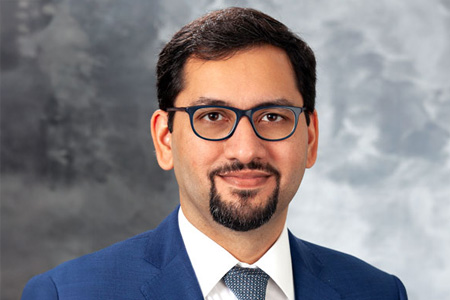
| Meet the University of Wisconsin-Madison’s Muhammed Murtaza Director of the Center for Human Genomics and Precision Medicine, and Associate Professor of Surgery |
 |
Research area In early applications of liquid biopsies, researchers analyzed the DNA in blood plasma to determine which cancer mutations existed and which medications could be used for treatment. Scientists now realize that a smaller, but detectable fraction of DNA is found in patients with early-stage cancer and are using DNA detection in individuals at high risk for cancer to diagnose patients. The research team discovered that it was possible to analyze plasma DNA from samples as small as blood spots and have been testing different devices and blood spot cards that separate plasma at collection. They developed an approach for analyzing cancer DNA from blood spot samples that could allow collection of blood spot samples in clinic or at home, and received a 2024 WARF Innovation Award for paving the way to make early screening and detection of cancer easier and more cost-effective.
What excites you about your work?
“Our latest work extends our research on analyzing DNA from blood samples to these plasma-separating blood spots. How much DNA can we get, and are the fragmentation patterns we’re interested in preserved here in blood spots? The results look very comparable. Eventually, we want people to collect blood samples in the clinic or at home, and we can analyze the DNA from those samples and make an assessment about cancer. Our vision is that this could enable more cost-effective, accessible, distributed cancer diagnostics.”
What do you hope to achieve?
“We have proof-of-principle data that these fragmentation patterns are preserved in plasma-separating dried blood spots. The next step is to expand to a real-world study, in which we ask cancer patients for samples and validate our current findings. The process of collecting the blood spot itself is essentially simple but needs to be optimized. Eventually, we hope to take this out into a trial where we look at at-risk patients and see how accurately we can predict cancer diagnoses. Those are the steps ahead of us. For now, we’re focused on validating our findings and getting our findings out into the field.”
The invention by Prof. Murtaza might become a game changer not only for early cancer detection but also for the ubiquitousness of it. It could enable a patient to send a drop of his/her blood and be screened for cancer.
– Rafael Diaz, WARF, Licensing Manager
Want to learn more?
Rafael Diaz, [email protected], 608.960.9847