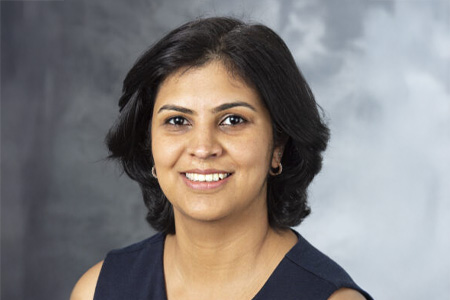
| Meet the University of Wisconsin-Madison’s Pallavi Tiwari Vilas Distinguished Achievement Professor, Radiology, Biomedical Engineering, Medical Physics Co-Director, Imaging and Radiation Sciences Program, Carbone Cancer Center |
 |
Research area IDiA Lab focuses on developing artificial intelligence (AI) and machine learning approaches for applications in oncology and neurological disorders. IDiA lab focuses on identifying computerized image-based (also known as radiomic) phenotypes and their associations with genomics (radiogenomics) and histo-pathology (radio-pathomics) for disease characterization. The lab’s vision is to conduct interdisciplinary and translational research in personalized diagnostics towards early diagnosis, prognosis and response to treatment for oncology and neurological disorders. Through clinical collaborations and research efforts, the group aims to build technologies with a potential for near-term clinical impact in customizing personalized treatments and improving patient survival.
What excites you about your work?
“I’m excited about using AI and machine learning in the context of multimodal data–imaging and digital pathology—and combining disparate sources of info to create models that provide diagnostic, prognostic and predictive information. For patients, can we predict the outcome of a drug and recurrence of disease? That information could lead to treatment course changes. Understanding how much benefit a patient will get from chemotherapy is a very important question that isn’t currently being answered, and data-driven approaches have huge potential for answering questions. I took on the challenge 12 years ago to study brain tumors, a rare and severely understudied disease. The tools and approaches we’re developing are being tested in adult and pediatric brain tumors, as well as other solid tumors, like pancreatic and breast cancers.”
What do you hope to achieve?
“My startup company, LivAi Incorporated, is focused on translating some of our inventions into clinical practice and using these approaches to impact patients’ lives. I think the timing of all of this is ideal because now people are starting to understand the power of AI, and with that, there is better appreciation for using these approaches in clinical practice. My vision is to get to the point where this research can have an impact in clinical care. We also collaborate closely with pharma companies on co-development to bridge the gap in clinical trial recruitment and response assessment, where computational imaging and AI could really move the needle and improve drug/treatment outcomes in cancer patients.”
Prof. Tiwari’s goal is to improve cancer diagnosis and treatment using AI to transform the health care experience. We’re proud to support her technologies to benefit patients worldwide.
– Jeanine Burmania, WARF, Senior Director, IP and Licensing
Want to learn more?
Jeanine Burmania, [email protected], 608.960.9846