Two UW-Madison teams selected from 350+ innovation disclosures
CONTACT:
Jeanan Yasiri Moe
Director of Strategic Communications and Public Affairs
[email protected] | (608) 960-9892
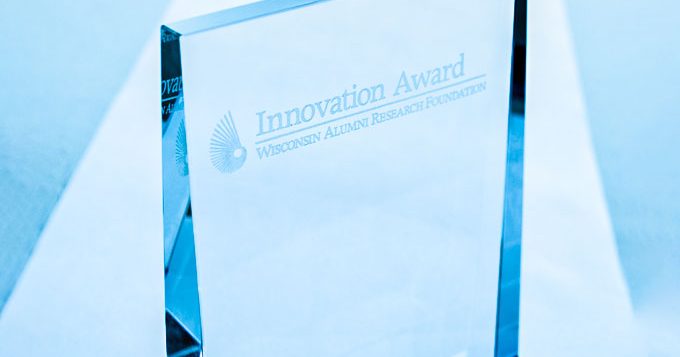
MADISON, Wis. – Soybeans engineered to produce both a vibrant, eco-friendly red dye and a brain-boosting compound, and a natural herbicide that could replace synthetic ones with a safer, greener alternative have taken top honors from WARF.
The first 2025 WARF Innovation Award has been given to the University of Wisconsin-Madison’s Hiroshi Maeda, professor of botany; graduate student Soyoung Jung; Ray Collier from the Wisconsin Crop Innovation Center; and plant and agroecosystem scientists Shawn Kaeppler and Heidi Kaeppler for their work, Soybeans engineered for color and brain health.
The team developed soybeans that produce high levels of betalain, a natural red pigment found in beets and some cactus fruit. This sustainable coloring could replace synthetic food dyes, which pose health and environmental risks. The soybeans also accumulate L-DOPA, a compound used in brain health supplements, raising the possibility of soy-based food products that are both colorful and beneficial to cognitive function.
The other winning team includes Paige Henning, postdoctoral researcher in the Center for Genomic Science Innovation; scientist Benjamin Minkoff; and Michael Sussman, professor of biochemistry, for their work, Ecofriendly herbicide offers targeted weed control.
Their new herbicide system uses a natural plant peptide, SPH, to suppress and kill a wide variety of weeds. SPH targets a receptor found in nearly all plant species, giving it broad activity. The researchers showed that removing this receptor from crops makes them resistant to SPH, enabling selective weed control. The result is an ecofriendly herbicide that could simplify farming and reduce environmental impact.
An independent panel of judges selected the winners from a field of six finalists drawn from hundreds of invention disclosures submitted to WARF over the prior 12 months. The winning teams each receive an award of $10,000, with the funds going to the named UW-Madison inventors.
“As WARF celebrates 100 years of partnership with UW-Madison, the Innovation Awards continue to highlight groundbreaking work happening across campus,” says Erik Iverson, CEO of WARF. “This year’s nominees exemplify the kind of forward-thinking research that has defined our legacy and will shape the next century of impact.”
The other 2025 WARF Innovation Award finalists are:
Smart scheduling over composable GPUs
Ming Liu, assistant professor of computer science, has created a system that dynamically allocates GPU resources, improving the efficiency and speed of AI and other high-performance computing applications. The technology adapts in real time to optimize hardware usage.
New light-extracting structure could boost quantum device performance
Professors Mikhail Kats and Jennifer Choy, along with graduate student Minjeong Kim, have designed a low-cost silicon structure that boosts light output from quantum materials without surface damage—potentially advancing quantum sensors and communication systems.
Recyclable protein degraders could boost cancer immunotherapy
Quanyin Hu, assistant professor of pharmacy, and postdoctoral researcher Peixin Liu have developed McR-TACs, a new class of protein degrader that targets disease-related proteins on and outside cells. These degraders are recycled by the cells, potentially improving the durability and effectiveness of cancer immunotherapy treatments.
Targeted eye therapy could improve treatment for vision loss
David Gamm, professor of ophthalmology and visual sciences, and postdoctoral researcher Celia Bisbach have developed a targeted therapy for retinal diseases that eliminates harmful proteins at the disease site, reducing injections, preserving healthy tissue and offering hope for patients with macular degeneration.
About WARF
Celebrating a century of service in 2025, the Wisconsin Alumni Research Foundation (WARF) patents and licenses discoveries from UW-Madison research, manages an investment portfolio generated from licensing and investment proceeds, and provides annual grants to the University of Wisconsin-Madison and the Morgridge Institute for Research to support further scientific investigation and research. By driving collaborations among researchers, investors, industry and entrepreneurs, WARF commercializes innovations from campus through various initiatives. WARF Accelerator improves the commercialization potential of university intellectual property through industry engagement and investment in proof-of-concept milestones to validate market potential, demonstrate commercial value and de-risk technology. WARF Therapeutics partners with UW-Madison and Morgridge Institute researchers employing an industry-focused approach to improve the value propositions of drug candidates. WARF Ventures is an early-stage venture fund that invests in startups based on UW/WARF technologies. Learn more at warf.org.
###